


Monocouche render is a high-performance, cement-based external wall finish. The name is derived from the French for "one coat," signifying its primary benefit: achieving a decorative, weather-resistant finish in a single application process.
1. Composition and Technology
-
Material Base: It is formulated with white Portland cement (unlike traditional grey cement), which allows for vibrant, consistent pigmentation throughout the material.
-
Additives: It contains polymer modifiers, hydrated lime (for flexibility), and hydrophobic agents for water repellency.
-
Through-Colour: Because the pigment is mixed into the render itself, it does not require painting. If the surface is chipped, the colour remains consistent underneath.
2. Key Benefits
-
Speed of Installation: Completed in a "one-coat, two-pass" system, reducing on-site labour and scaffolding time compared to traditional multi-coat renders.
-
Breathability: While water-repellent, it remains vapour-permeable, allowing moisture to escape from the building's substrate and reducing damp risk.
-
Durability: High-quality systems applied in 2026 have an expected lifespan of 25+ years with minimal maintenance.
-
Low Maintenance: Requires no repainting; routine cleaning (e.g., low-pressure washing) is typically sufficient.
3. Application Process
Monocouche is typically applied to stable masonry substrates like brick, blockwork, or concrete at a thickness of 15mm to 25mm.
-
Preparation: Priming may be required to control suction levels on highly absorbent materials like aerated blocks.
-
Application: Applied in two passes ("wet-on-wet") to form a single monolithic bond.
-
Reinforcement: Fibreglass mesh is often embedded in the first pass around high-stress areas (windows/doors) to prevent cracking.
-
Finishing: Once the render has begun to set (5–36 hours), it is "scraped back" using a nail float to achieve a textured, stone-like finish.
4. Cost and Market Options
The typical cost for monocouche rendering in the UK ranges from £65 to £85 per m² including labour and materials.

General Questions
1. Monocouche is water-resistant and breathable, meaning it protects against rain while allowing moisture vapor to escape from the building. It is not as "hydrophobic" (water-repelling) as silicone render, making it slightly more prone to algae growth in shaded or damp areas.
2. Total project costs for a standard semi-detached house usually range from £7,000 to £9,000, depending on scaffolding requirements and the condition of your existing walls.
-
What causes the green or red stains on render? These are usually algae or lichen growth caused by moisture and shade. It is common in the UK climate, especially on north-facing walls. Regular application of a biocide treatment can prevent this from returning.
-
Can you apply Monocouche over old render? Generally, no. For the best bond and longevity, old render should be hacked off to expose the original brick or blockwork. If the substrate is sound, we may use a "key coat" or bonding agent, but a fresh start is always recommended.
4. Application and Suitability
-
Is it crack-resistant? While Monocouche is more flexible than traditional cement, no render is 100% crack-proof. To minimize risk, we embed a fibreglass mesh into the first pass of the render to help it withstand minor building movements.
-
What weather conditions are needed for application? For a perfect cure, Monocouche should be applied in dry conditions with temperatures between 5°C and 25°C. We avoid rendering in freezing temperatures or heavy rain, as this can lead to "lime bloom" (white staining) or uneven drying.
Render Information
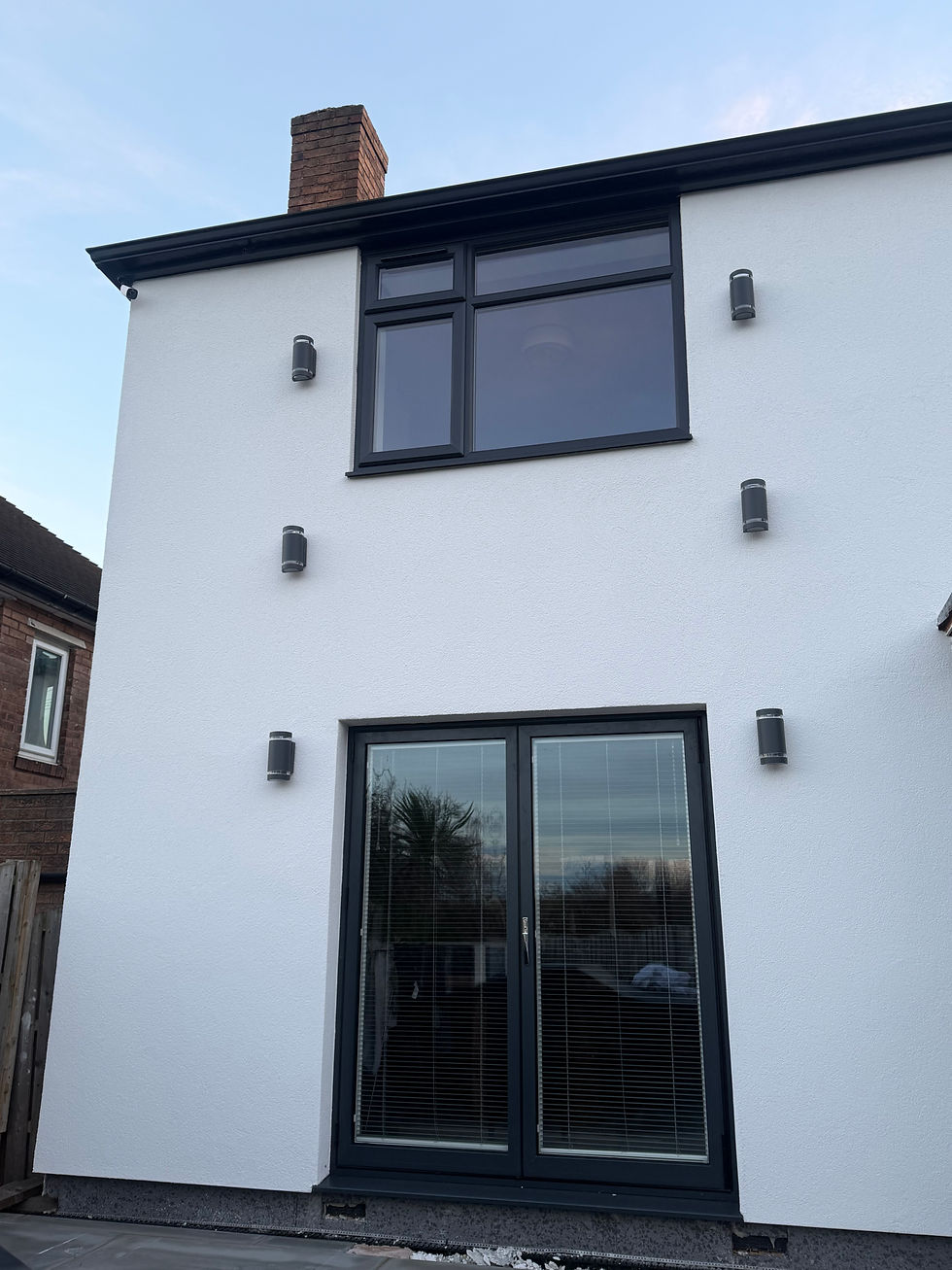
-
How much does it cost in 2026? The average cost typically ranges from £65 to £75 per m² including labour and materials. Premium or complex projects can reach up to £95 per m².
-
Does it add value to a property? Yes, it is considered a valuable investment that improves "kerb appeal" and can increase property value by providing a fresh "new build" look to older homes.
-
How does the price compare to silicone render? Monocouche is generally cheaper to install than silicone render, which often costs between £65 and £80 per m².
costing Breakdown
-
How long does it last? When applied properly, it has an expected lifespan of up to 25 years with minimal maintenance.
-
Does it need painting? No. It is a "through-coloured" system where pigment is mixed into the material, meaning it retains its colour for years without the need for repainting.
-
Is it "maintenance-free"? No. It requires occasional cleaning (usually once or twice a year) with a biocide or low-pressure wash to remove dirt and prevent algae growth, which is common on shaded or north-facing walls.
Maintenance
-
Does it crack? While durable, it is cement-based and less flexible than silicone. It can develop hairline cracks due to structural movement or rapid temperature changes. Proper use of reinforcement mesh during installation can reduce this risk.
-
Why is my render turning green? Algae build-up is a common issue because monocouche is more prone to water absorption than hydrophobic silicone systems.
-
Can it be repaired? Small chips or fine hairline cracks can be repaired using colour-matched patching materials. However, larger repairs can be difficult to hide perfectly.
Common Questions
-
What surfaces can it be applied to? It is ideal for standard concrete blocks. It can also be applied to brick or aerated blocks, though these often require a primer or base coat to manage water suction levels.
-
Is it waterproof? It is water-resistant and weatherproof, but not entirely hydrophobic like silicone. It is breathable, allowing moisture vapour to escape the building.
-
Can it be used with External Wall Insulation (EWI)? Generally, no. Monocouche is a "thick-coat" system that is often too heavy for EWI; thin-coat silicone or acrylic renders are required for insulation projects.
-
What temperatures can it be applied at? Manufacturers recommend a minimum of 5°C and a maximum of 30°C for successful application.
Appilcation

Can You Apply Monocouche On EWI
Standard monocouche render is generally not recommended for use directly over external wall insulation (EWI). While some specific systems exist, thin-coat silicone renders are the industry standard for EWI projects due to technical and structural constraints.
Key Technical Challenges
-
Weight: Monocouche is a "thick-coat" render applied at approximately 15mm–18mm. This adds significant weight (load) to the insulation boards, which can lead to structural failure or detachment from the wall over time.
-
Flexibility: Insulation boards (like EPS or Mineral Wool) expand and contract with temperature changes. Because monocouche is cement-based and relatively rigid, it is prone to cracking as it cannot flex with the underlying insulation.
-
Adhesion: Thin-coat silicone renders are engineered specifically for EWI systems to provide the necessary adhesion and flexibility that cement-based monocouche lacks.
Exceptions and Alternatives
-
Specialised Lightweight Systems: Some manufacturers offer lightweight or modified monocouche renders specifically designed to be compatible with certain EWI systems. Always verify compatibility with the specific EWI manufacturer's technical data.
-
Thin-Coat Silicone Render: This is the primary choice for EWI in 2026. It is applied much thinner (approx. 1.5mm–3mm), is highly flexible, and maintains superior hydrophobic (water-repellent) properties.
-
Substrate Suitability: Monocouche is far better suited for stable masonry substrates such as brickwork, concrete blocks, or clay blocks rather than insulation.